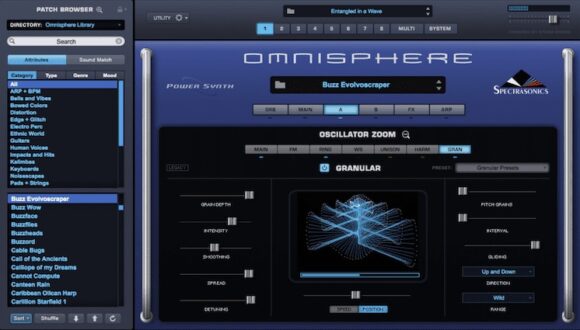
When it comes to flagship virtual instruments, few names carry as much weight as Spectrasonics Omnisphere. Widely regarded as one of the most powerful and versatile synthesizers on the market, Omnisphere is more than just a synth—it’s a complete sound design ecosystem.
In this article, we’ll explore what makes Omnisphere so special, how it works, and who it’s best suited for.
What Is Omnisphere?
Omnisphere is a hybrid software synthesizer developed by Spectrasonics. It combines:
-
advanced synthesis engines
-
an enormous sample-based sound library
-
deep modulation and sound-design tools
Unlike traditional synths focused on a single synthesis method, Omnisphere blends sample playback, wavetable synthesis, granular processing, and virtual analog synthesis into one instrument.
The Sound Library – A World of Inspiration
One of Omnisphere’s biggest strengths is its massive sound library, which includes over 14,000 sounds.
What’s Inside
-
Pads and atmospheric textures
-
Cinematic soundscapes
-
Bass sounds and leads
-
Arpeggios and rhythmic sequences
-
Organic and experimental sounds
The library features both classic synth tones and highly creative, cinematic material recorded from real-world sources.
Hybrid Synthesis Engine
Each Omnisphere patch can use two layers, and each layer can be:
-
sample-based
-
wavetable-based
-
granular
This hybrid approach allows for incredibly complex and evolving sounds that would be difficult—or impossible—to create with a single synthesis method.
Advanced Modulation System
Omnisphere’s modulation system is deep yet intuitive.
Modulation Sources
-
LFOs
-
Envelopes
-
Modulation matrix
-
Performance controls
Almost any parameter can be modulated, allowing for subtle movement or dramatic transformations.
Built-In Effects and Processing
Omnisphere includes a powerful effects engine with over 50 high-quality effects, including:
-
Reverbs and delays
-
Distortion and saturation
-
Filters and modulation effects
-
Amp and cabinet models
Effects can be applied per layer, per patch, or globally—making Omnisphere a complete production environment on its own.
Hardware Synth Integration
A unique feature of Omnisphere is hardware synth integration. Many popular hardware synthesizers can be mapped directly to Omnisphere, allowing:
-
automatic parameter mapping
-
preset browsing from hardware
-
hybrid hardware/software workflows
This feature bridges the gap between physical and virtual instruments.
Performance and Preset Browsing
Despite its depth, Omnisphere is surprisingly playable.
Features include:
-
intelligent preset browser
-
sound categories and tags
-
performance macros
-
live-friendly controls
You can quickly find inspiration—or dive deep into sound design.
Best Use Cases
Omnisphere excels in many production scenarios:
-
Film and game scoring
-
Electronic and ambient music
-
Pop, hip-hop, and EDM
-
Experimental sound design
-
Layering and texture creation
It’s especially popular among composers who need rich, evolving sounds.
Pros and Cons
Pros:
-
Massive, high-quality sound library
-
Extremely deep sound design capabilities
-
Excellent preset management
-
Frequent updates and expansions
-
Strong industry reputation
Cons:
-
High price compared to standard synths
-
Large installation size
-
Can be overwhelming for beginners
Omnisphere vs Other Synths
Compared to synths like Serum, Massive X, or Vital:
-
Omnisphere focuses more on atmosphere, depth, and hybrid sound design
-
Less about aggressive EDM sound creation
Many producers use Omnisphere alongside more specialized synths.
Spectrasonics Omnisphere is not just a synthesizer—it’s a creative universe. While it may be overkill for simple tasks, its depth, sound quality, and flexibility make it one of the most respected instruments in modern music production.
If you’re looking for inspiration, cinematic textures, and limitless sound design potential, Omnisphere is a long-term investment that continues to deliver.