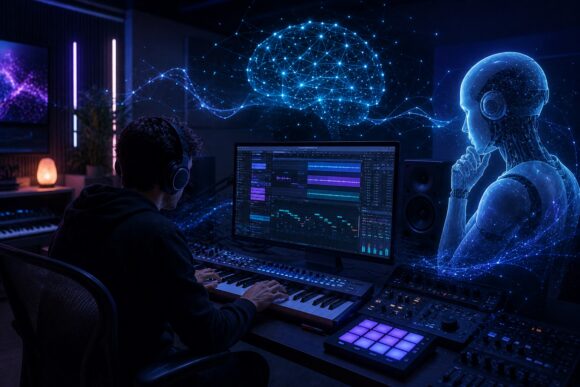
Artificial Intelligence (AI) has become one of the biggest technological revolutions of the decade, and the music industry is no exception. From generating melodies and mastering tracks to creating realistic vocal performances, AI is transforming the way producers work. While these tools offer exciting opportunities, they also raise important questions about creativity, originality, and copyright.
In this article, we’ll explore how AI is changing music production, its biggest advantages, potential risks, and how producers can use it responsibly.
What Is AI in Music Production?
Artificial Intelligence in music production refers to software that uses machine learning and advanced algorithms to assist with creative or technical tasks.
AI can help with:
- Composing melodies and chord progressions
- Generating drum patterns
- Sound design
- Vocal processing
- Mixing and mastering
- Audio restoration
- Lyric generation
- Music analysis
Rather than replacing producers, AI is increasingly becoming a creative assistant.
How AI Is Changing Music Production
Modern AI tools can dramatically speed up production workflows.
Tasks that once took hours can now be completed in minutes, including:
- Removing unwanted noise
- Matching EQ curves
- Suggesting chord progressions
- Generating instrument ideas
- Creating realistic backing vocals
This allows producers to spend more time focusing on creativity rather than repetitive technical work.
Benefits of AI for Music Producers
1. Faster Workflow
AI can automate repetitive tasks such as:
- Audio cleanup
- Sample organization
- Tempo detection
- Pitch correction
- Stem separation
This saves valuable production time.
2. Creative Inspiration
Sometimes the hardest part of producing music is getting started.
AI can generate:
- Melodies
- Harmonies
- Rhythmic ideas
- Sound variations
These ideas can serve as creative starting points rather than finished compositions.
3. Better Mixing Assistance
Modern AI-powered mixing tools can:
- Detect frequency masking
- Suggest EQ adjustments
- Balance levels
- Analyze stereo width
While they shouldn’t replace your ears, they can help identify issues quickly.
4. Accessibility for Beginners
AI lowers the learning curve.
New producers can:
- Create demos faster
- Understand mixing concepts
- Learn production techniques
- Experiment without needing years of experience
This makes music production more accessible than ever before.
The Challenges of AI in Music Production
Despite its advantages, AI also presents several concerns.
1. Loss of Originality
If thousands of producers use the same AI-generated ideas, music can start to sound similar.
Originality comes from personal creativity—not from accepting every AI suggestion.
2. Copyright and Ownership
One of the biggest questions surrounding AI-generated music is:
Who owns the result?
Depending on the platform:
- You may own the output.
- The platform may retain certain rights.
- The legal status may vary by country.
Always read the licensing terms before using AI-generated content commercially.
3. Over-Reliance on Technology
AI should assist—not replace—your skills.
If producers rely entirely on AI for:
- Composition
- Mixing
- Arrangement
…they may never develop their own musical instincts.
4. Ethical Concerns
Some AI systems are trained using existing music, raising debates about:
- Fair use
- Artist compensation
- Creative ownership
- Copyright infringement
The legal landscape continues to evolve as AI becomes more common.
The Best Ways to Use AI
The most successful producers use AI as a tool—not a substitute.
Good uses include:
- Brainstorming ideas
- Organizing samples
- Cleaning recordings
- Speeding up editing
- Generating rough sketches
Final creative decisions should remain in human hands.
What AI Cannot Replace
Despite rapid advancements, AI still cannot fully replicate:
- Human emotion
- Personal experiences
- Artistic intention
- Cultural influences
- Creative risk-taking
Great music connects with listeners because it tells a human story.
How to Stay Competitive in the AI Era
Instead of fearing AI, learn how to work alongside it.
Focus on developing:
- Musical taste
- Critical listening
- Sound selection
- Storytelling through music
- Communication and collaboration
These are skills that technology cannot easily replace.
Common Misconceptions About AI
“AI will replace music producers.”
Not likely.
AI can generate ideas, but producers still provide:
- Vision
- Emotion
- Creative direction
- Final decision-making
“AI music is automatically professional.”
Not necessarily.
AI-generated material often requires:
- Editing
- Arrangement
- Mixing
- Human refinement
Quality still depends on the producer.
The Future of AI in Music Production
Over the next few years, AI will likely become even more integrated into DAWs and plugins.
We can expect:
- Smarter mixing assistants
- Personalized sound design
- Real-time arrangement suggestions
- More advanced vocal processing
- Better collaboration between humans and AI
The future isn’t about humans versus AI—it’s about humans working with AI.
Artificial Intelligence is reshaping music production in exciting ways. It can improve workflow, spark creativity, and make professional tools accessible to more people. However, AI should be viewed as an assistant rather than a replacement for human creativity.
The producers who thrive in the future won’t be the ones who avoid AI—they’ll be the ones who learn how to use it wisely while continuing to develop their own artistic voice.
Ultimately, the most powerful tool in any studio isn’t artificial intelligence.
It’s human imagination. 🎵