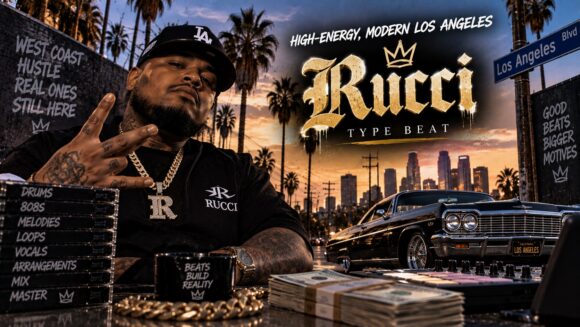
Inglewood’s own Rucci is one of the most prominent voices in modern West Coast hip-hop. Known for his explosive energy, rapid-fire street delivery, and deep connection to LA club culture, his music demands a very specific sonic backdrop. Crafting a Rucci type beat means combining the classic elements of traditional West Coast ratchet music with the dark, heavy-hitting aesthetics of modern California street trap.
Here is your step-by-step production blueprint to creating a high-velocity, club-ready Los Angeles anthem.
1. Lock In the High-Velocity West Coast Tempo
Rucci beats are built for high-energy live performances and packed nightclub dance floors. The rhythm needs to feel urgent, fast-paced, and driving.
- The Target Tempo: Set your DAW project tempo between 98 and 105 BPM.
- The Groove: Enable a subtle 16th-note swing quantization (around 52% to 55%) on your drum sequencer to pull the hits slightly off the rigid digital grid, creating that definitive California bounce.
2. Settle on a Minimalist, Street-Ready Sound Palette
Following the template set by West Coast production giants like Ron-Ron and JoogSZN, Rucci beats are intentionally sparse. Minimal instrumentation ensures that the production leaves maximum room for an aggressive, rhythmic vocal delivery.
- The Lead Pluck: Look for dry synthetic bells, a sharp plucky sine-wave synth, a toy-like music box, or a clean grand piano played in its highest register.
- The Scale: Write a simple, repetitive 2-bar or 4-bar melody loop using a minor scale (like G# Minor or D Minor) to give the track a confident, menacing, and urgent attitude.
3. Layer the Iconic “Ratchet” Percussion Grid
The percussion pattern is the actual backbone of a Rucci type beat. It needs to provide a relentless, syncopated movement.
- The Handclap: Place a loud, sharp digital clap or a heavy rimshot strictly on the 2 and 4 beats of every bar.
- The Off-Beat Rimshot: This is mandatory for the authentic LA bounce. Place a metallic rimshot, woodblock, or sharp percussion hit on the off-beats (the “and” of every beat).
- The Vocal Chant: Layer the classic “Hey!” or “Yeah!” vocal chant on the off-beats alongside your percussion to instantly inject party-ready energy into the rhythm. Keep the hi-hats to a straightforward eighth-note pattern with occasional rapid triplet rolls right before the clap hits.
4. Layer a Short, Punchy, Ground-Shaking 808
Unlike Southern trap beats that utilize long, bleeding sub-basslines, the modern Los Angeles underground uses short-decay 808s that function almost like an extra drum instrument.
- The Selection: Pick a short, punchy 808 bass with a clean sub-body and a touch of mid-range saturation so it stands out perfectly on phone and car speakers.
- The Pattern: Program the 808 to strictly match your irregular, syncopated kick drum hits. Keep the bass completely silent between hits to maximize the physical tension and bounce of the track.
5. Arrange for Viral Drops and Mutes
Because the beat is so minimalistic, you must use sudden arrangement shifts to keep the track evolving and engaging.
- The Naked Intro: Start with just the lone melody pluck and the vocal chants for 4 to 8 bars to let the listener lock into the groove before the rhythm drops.
- The Explosion: Drop the heavy kick, punchy 808, and main claps all at once for high impact.
- The Verse Pocket: For the first 4 bars of the verse, drop out the heavy 808 and the kick drum entirely, leaving just the hi-hats, claps, and melody. This sudden breakdown gives the rapper the perfect pocket to establish a rapid-fire flow before the heavy rhythm slams back in to drive the song forward.