Dr. Dre is the architect of West Coast hip-hop and one of the most meticulous producers in music history. From the laid-back G-Funk of The Chronic to the crisp, cinematic minimalism of 2001 and his work with Eminem and 50 Cent, Dre defined the sound of premium hip-hop. A Dr. Dre type beat means three things: an immaculately clean mix, a heavy rhythmic bounce, and a legendary low-end.
Here is your step-by-step production blueprint to capturing the legendary Aftermath sound.
1. Dial In the Dr. Dre Tempo and Swing
Dre’s beats are famous for their steady, marching, and head-nodding groove. They feel calculated, precise, and powerful.
- The Target Tempo: Set your project tempo strictly between 90 and 95 BPM.
- The Quantization: Keep your main drums rigidly on the grid to enforce a solid, military-like precision. However, apply a very subtle swing (around 52-54%) exclusively to your percussion and hi-hats to inject a human bounce.
2. Choose the Sound Palette of a Perfectionist
Dr. Dre rarely relies on over-layered digital synths. He favors high-quality analog instruments, live musicianship, and crisp, isolated sounds.
- The Keyboards: Look for a dark, melancholic grand piano or classic Fender Rhodes electric piano chords written in a minor scale.
- The Strings & Brass: Use dramatic, staccato orchestral strings (violins and cellos playing short, sharp notes) to build tension.
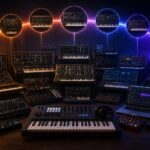
- The Signature Worm Synth: Find a monophonic analog synthesizer lead with a high-pitched sawtooth wave. Turn up the glide (portamento) to create that iconic, winding West Coast whistle melody.
3. Program Raw, Loud, and Punchy Drums
Dre’s drum mixing is legendary. His kicks and snares punch through speakers with incredible force and clarity.
- The Kick: Pick a punchy, acoustic-leaning kick drum with a massive mid-range “thud.” Keep your pattern repetitive and simple.
- The Snare: Layer a crisp, cracking acoustic snare with a digital clap. Make sure it snaps perfectly on the 2 and 4 beats, and turn it up loud in the mix.
- The Off-Beat Percussion: Use standard eighth-note hi-hats. To get that authentic 2001 vibe, place a sharp, metallic rimshot, woodblock, or tambourine hit on the off-beats (the “and” of every beat).
4. Layer a Thick, Melodic Analog Bassline
A Dr. Dre beat does not use modern sliding trap 808s. It relies on deep, driving, and incredibly groovy bass instrumentation.
- The Sound: Use a heavy, warm analog synthesizer bass (like a classic Moog Minimoog patch) or a deep, muted electric bass guitar.
- The Flow: Write a continuous, walking bassline that locks in seamlessly with the kick drum. Let the bass carry the groove by bouncing between the root notes of your chords, leaving a massive low-end pocket.
5. Arrange and Mix for Absolute Sonic Clarity
Dre is a master of minimalism. Every instrument must have its own distinct space in the frequency spectrum without clashing.
- The Intro: Start with a signature sound effect—like a record scratch, a guitar pluck, or a lone piano chord—to instantly grab attention for the first 4 to 8 bars.
- The Verse Pocket: Strip the beat down during the verses. Drop out the heavy strings and high synth leads, leaving just the piano loop, the bassline, and the hard-hitting drums so the rapper has maximum space for their delivery.
- The Chorus Drop: Bring back all the melodic layers—the dramatic strings, the soaring whistle synth, and additional vocal harmonies—to make the section feel grand, cinematic, and unforgettable.