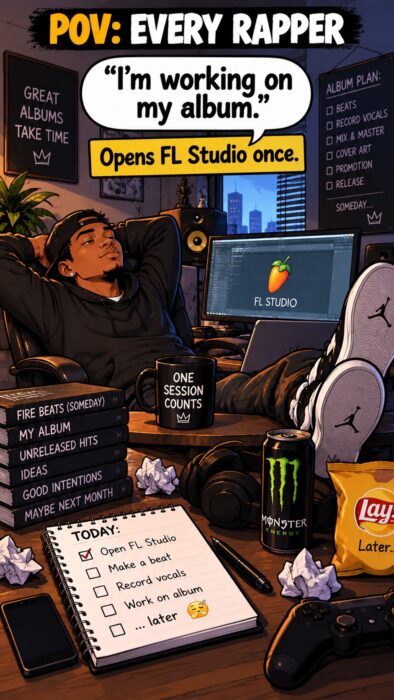
Every rapper has probably said it at some point: “I’m working on my album.” It sounds serious. It sounds productive. It sounds like there is a whole plan behind it — finished songs, carefully selected beats, a tracklist, artwork and maybe even a release date. You can already imagine the finished project and the reaction it will get from listeners.
Then FL Studio gets opened.
Maybe a new project is created, a few drums are added and a melody is tested. After twenty minutes, the rapper decides to take a break and somehow that break turns into the rest of the day. The next day, there is another idea. Then another. Before long, there are dozens of projects sitting on the computer, but the album itself hasn’t moved much further than the original announcement.
This is one of the funniest realities of making music. Talking about an album is easy because the idea itself is exciting. Actually making one requires consistency, patience and a lot of work that isn’t nearly as glamorous as imagining the final product.
The difference between planning and making
An album is a much bigger project than simply recording a collection of songs. There are beats to choose, lyrics to write, vocals to record, edits to make and mixes to finish. Then there is mastering, artwork, distribution, promotion and everything that happens after the music is technically finished.
Thinking about all those things can create the feeling that you’re making progress even when you’re not. You might spend an entire evening organizing samples, browsing plugins or looking for the perfect beat without actually completing anything. Technically, you were working in the DAW, but at the end of the night there still isn’t a finished song.
Music production is particularly good at making procrastination look productive.
You can tell yourself that you’re “working on the album” because you opened FL Studio and spent two hours changing sounds. But if the project still consists of eight bars and three different snare choices, the album hasn’t exactly moved forward.
The endless collection of unfinished projects
Every producer probably has a folder full of unfinished ideas. There are beats that started with a great melody, songs that have a complete verse but no hook, projects that were abandoned after the first recording session and files with names that become increasingly desperate as time goes on.
There is nothing wrong with unfinished projects. Experimentation is an important part of making music, and not every idea deserves to become a finished song. The problem starts when starting new projects becomes easier than finishing old ones.
An artist can have fifty great ideas and still have no album.
That’s because an album isn’t built from ideas. It’s built from finished songs.
The excitement of the first idea
One reason artists struggle to finish albums is that the beginning of a song is often much more exciting than the middle. When you first hear a beat, everything feels possible. You imagine the hook, the verses and the overall direction. Your brain fills in all the missing pieces and makes the song sound incredible in your head.
Then you actually have to write it.
That’s where things become harder. The melody you imagined doesn’t work as well as expected. The lyrics aren’t coming together. The vocals don’t sound the way you wanted. Suddenly the new beat you’ve just discovered seems much more exciting than the song you were supposed to finish.
So you start another project.
And the cycle begins again.
Every new song can feel like “the one”
Artists are naturally drawn toward new ideas. A fresh beat can give you an immediate burst of motivation, while finishing an older project can feel like work. That’s why it is so easy to keep starting new songs.
The problem is that every new project pushes the album further away.
At some point, you have to accept that the song you’re working on doesn’t need to be perfect. It needs to be finished. You can always improve your skills on the next track. You can always make a better album later. But you can’t release something that exists only as an unfinished project file.
This is especially important for artists who constantly compare their current work with the newest thing they’ve created. If every new song makes the previous one feel outdated, the tracklist will never be finished.
Consistency matters more than motivation
Motivation feels great when it appears, but it isn’t something you can depend on. Some days you can sit down and create three songs without thinking twice. Other days you can stare at the DAW for an hour and question whether you have ever made a good beat in your entire life.
That’s normal.
The artists who actually finish large projects aren’t necessarily motivated every day. They simply keep working even when the excitement isn’t there. They build routines and make steady progress instead of waiting for the perfect creative mood.
You don’t need to finish an entire album in one weekend. You just need to keep completing songs. One finished track becomes two, two become five, and eventually you have enough material to start thinking about the album as a real project rather than an idea.
Producers see this all the time
For producers, this situation can be particularly familiar. A rapper hears a beat and immediately says it’s perfect for the album. They talk about recording it, mention the concept and promise to send vocals soon.
The producer sends the files and waits.
Then nothing happens.
A few weeks later, the artist asks for more beats because they’re still working on the album. The producer sends more. Then more time passes.
Eventually, it becomes clear that the artist isn’t actually building an album yet. They’re collecting possibilities.
There is nothing wrong with collecting ideas, but at some point the artist needs to start making decisions. Which songs are staying? Which beats fit together? What is the concept? What needs to be recorded? What actually has to be finished before the album can exist?
Without those decisions, the project can remain in development forever.
You don’t need to do everything at once
One of the best ways to avoid feeling overwhelmed is to stop thinking about the entire album every time you sit down to work. Instead of asking yourself, “How am I going to finish this whole project?”, focus on the next task.
Maybe today you’re finishing the second verse. Tomorrow you edit the vocals. The next session is for arranging the beat. After that, you send the song for mixing.
Breaking the project into smaller pieces makes it much easier to keep moving.
An album can feel enormous when you look at it as one giant task. It becomes much more manageable when you look at it as a collection of individual songs that need to be completed one at a time.
Don’t let perfection become procrastination
There is also a difference between having high standards and refusing to finish anything. Wanting your album to sound great is obviously a good thing. The problem is constantly convincing yourself that the music isn’t ready because there is always something else you could change.
There will always be another plugin you could try. Another vocal take you could record. Another drum sound you could replace. Another mix revision you could make.
At some point, you have to decide that the song is finished.
Finishing doesn’t mean you think the track is flawless. It means you’ve reached a point where continuing to change things is no longer helping the song move forward.
That ability to finish is one of the most important skills an artist can develop.
The first album doesn’t need to be perfect
Your first album probably won’t represent everything you’re capable of. That’s completely normal. Your production will improve, your songwriting will evolve and your understanding of music will become stronger as you continue working.
That’s actually one of the reasons releasing music is so important. Every finished project teaches you something that another unfinished project can’t.
You learn how to sequence songs, how long a recording process actually takes, what your audience responds to and which parts of your workflow need improvement. The next album can benefit from everything you learned from the first one.
You don’t have to wait until you’re the best version of yourself before releasing music.
Opening FL Studio is only the beginning
There is nothing wrong with opening FL Studio, experimenting for a while and not finishing anything. Sometimes that’s exactly what creativity requires. You need sessions where you simply play around and see what happens.
The problem is when every session becomes that kind of session.
If you’re genuinely working on an album, eventually some of those experiments have to turn into finished songs. Otherwise, you’re not really building an album. You’re building a very impressive collection of unfinished FL Studio projects.
And every producer knows how quickly that collection can grow.
So the next time you tell someone, “I’m working on my album,” make sure you’re actually moving it forward. You don’t need to finish everything today, and you don’t need to know exactly what the final project will sound like from the beginning. Just keep finishing songs, making decisions and turning ideas into something concrete.
Because opening FL Studio once doesn’t make an album.
But opening it again tomorrow, finishing the song you started today and doing the same thing the day after that might eventually get you there.
And that is how 0.1% progress slowly turns into a finished record.