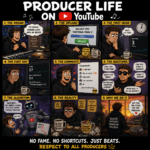
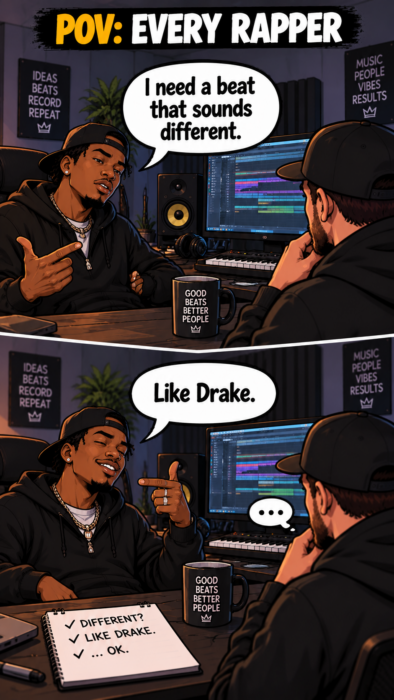
Every producer has heard some version of this conversation. An artist comes into the studio looking for something fresh and different. They don’t want the usual sound, they don’t want something predictable and they definitely don’t want a beat that sounds like everyone else.
So the producer starts thinking outside the box. Different drums, unusual melodies, unexpected sounds and a completely different arrangement are all on the table. The goal is to create something that feels original while still giving the rapper something they can actually work with.
Then the artist hears the first idea and says, “Yeah, that’s cool, but can you make it more like Drake?”
And suddenly the definition of “different” becomes a little more complicated.
The search for something original
Most artists genuinely want to stand out. Nobody wants to release a song and have listeners immediately say, “I’ve heard this exact thing a hundred times.”
At the same time, artists are influenced by the music they listen to. That’s completely normal. Every musician has references, favorite artists and sounds that inspire them. Those influences are often what help define an artist’s taste in the first place.
The tricky part comes when an artist wants something completely unique while using a very specific famous artist as the main reference.
It’s like asking a chef to prepare something nobody has ever tasted before and then handing them a photo of your favorite restaurant’s signature dish.
References are useful
There is nothing wrong with saying that you like a particular artist’s sound. In fact, references can be extremely helpful for producers.
If a rapper says they want something atmospheric, melodic and minimal, that’s useful information. If they add a few reference tracks, the producer can better understand the energy, arrangement and overall direction they’re imagining.
The important thing is to use references as inspiration rather than as a blueprint.
A good producer doesn’t necessarily need to recreate another artist’s sound. They can take the qualities that the artist likes and translate them into something new.
Maybe the rapper likes the atmospheric production. Maybe they like the combination of singing and rapping. Maybe they like the space in the arrangement or the emotional tone.
Those characteristics can be used without simply copying the original formula.
The “make it different” paradox
The funny part is that artists sometimes give producers two instructions that seem completely contradictory.
First: “I need something nobody has.”
Then: “Make it sound like this artist.”
The producer now has to find the tiny space between originality and familiarity.
Too different, and the rapper might not connect with it.
Too familiar, and it sounds like a copy.
That’s where production becomes more than simply making beats. The producer has to understand what the artist actually wants underneath the words.
When someone says they want a “Drake-type beat,” they might not literally want a copy of a Drake song. They might want a particular combination of mood, melody, drums and vocal space that they associate with his music.
That’s a much more useful way of interpreting the request.
Finding your own sound
Artists eventually have to face an important question: what makes your music yours?
Your sound isn’t necessarily created by avoiding every influence. That’s impossible. It’s created by combining your influences with your own personality, experiences and creative decisions.
Two artists can listen to the same music and still create completely different songs.
One might focus on melodies. Another might focus on lyrics. One might use aggressive delivery while another uses a softer vocal style. Their producers might use completely different sounds and arrangements.
That’s where individuality comes from.
You don’t have to sound like nobody else on Earth. You just need to develop enough of your own identity that people can recognize your music.
Producers have the same problem
This isn’t only an issue for rappers. Producers deal with it too.
An artist might say they want a beat that sounds completely fresh, but the producer also has influences. Certain drum patterns, chord progressions, sounds and arrangements naturally appear in their work because those are the things they enjoy making.
Developing an original production style takes time. It comes from experimenting, making mistakes, trying unusual sounds and occasionally making something that doesn’t work at all.
The failed experiments are part of the process.
Sometimes the strange beat that you almost deleted becomes the sound that finally separates you from everyone else.
Don’t be afraid of familiar sounds
There’s also no reason to completely avoid popular styles. Music constantly evolves by building on existing ideas.
Trap producers didn’t invent every individual drum sound. Boom bap producers didn’t invent drums. Melodic rap didn’t suddenly appear from nowhere.
Genres develop because artists take familiar elements and do something interesting with them.
The goal isn’t to avoid everything that has been done before. That’s impossible.
The goal is to add something of your own.
Give the producer better information
If you’re an artist, instead of simply saying, “Make it like Drake,” try explaining what you actually like about the reference.
Maybe you love the dark atmosphere. Maybe you like the emotional melodies. Maybe you want a beat with a lot of space for your vocals. Maybe you want something that feels expensive and cinematic without being overly complicated.
Those details give the producer much more freedom.
They can then create something that matches the feeling you’re looking for without being a copy of somebody else’s music.
That’s usually where better collaborations happen.
Original doesn’t always mean strange
Sometimes artists believe that a unique beat has to sound completely bizarre. It doesn’t.
A beat can have familiar drums, familiar instruments and a familiar structure while still feeling original because of the way those elements are combined.
Originality can be subtle.
It might be one unusual chord.
A different drum pattern.
A surprising transition.
A unique vocal texture.
An unexpected sample.
Or simply the way the artist performs over the instrumental.
You don’t need to reinvent music to create something memorable.
The best reference is sometimes yourself
One of the strongest ways to develop an identity is to study your own work.
Which songs feel the most natural?
Which beats do you keep coming back to?
Which melodies sound like something only you would make?
Which parts of your music do listeners respond to?
Over time, those patterns can reveal your own sound.
Eventually, instead of telling a producer, “I want something like Drake,” you might be able to say, “I want something that feels like my last track, but darker and more energetic.”
That’s a much stronger position to be in.
You’re no longer trying to find an identity through someone else’s music. You’re building on your own.
Different, but familiar
The best music often lives somewhere between originality and familiarity. Listeners want something they can understand, but they also want something that gives them a reason to keep listening.
That’s why completely experimental music isn’t automatically better, and familiar music isn’t automatically worse.
The real challenge is finding a balance.
Take the influences you love, understand why they work, and then use them as ingredients rather than instructions.
So the next time a rapper tells a producer, “I need a beat that sounds different,” and follows it with “Like Drake,” nobody needs to panic.
The producer just has to figure out what the artist actually means.
Because sometimes “make it like Drake” doesn’t mean “copy Drake.”
It means:
“Give me that feeling — but help me make it mine.”
And that’s a much more interesting creative challenge. 🎤🎹