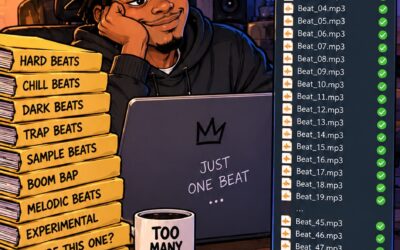
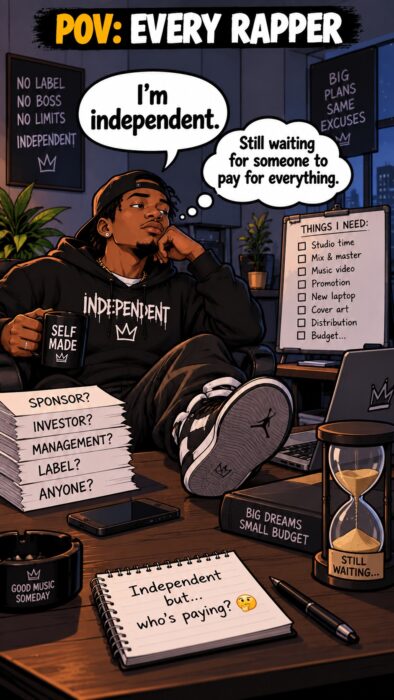
Being an independent rapper sounds great.
Additionally, there is no label telling you what to release, and no executive deciding which songs belong on your album.
No one stands over your shoulder demanding that you change your sound, and you keep control of your career.
At least, that’s the dream.
Then you look at the list of things you actually need to pay for.
Studio sessions, beats, mixing, mastering, artwork, music videos, distribution, advertising, social media promotion, travel and countless other expenses quickly remind you that independence doesn’t mean everything is free. It usually means you’re the one responsible for figuring out how to pay for it.
Studio sessions, beats, mixing, mastering, artwork, music videos, distribution, advertising, social media promotion, travel, and countless other expenses remind you that independence doesn’t mean everything is free. It usually means you’re the one responsible for figuring out how to pay for it.
The freedom comes with a bill
One of the biggest advantages of being independent is creative freedom. You can experiment with your sound without worrying about whether a label thinks the song is commercially safe. You can release singles instead of albums, change your style whenever you want and build your audience at your own pace.
The downside is that there is nobody else automatically covering the costs.
If you want a professional music video, someone has to pay for it. If you want a better mix, someone has to pay the engineer. If you want to promote your new release, that costs money too.
And unfortunately, saying “I’m an independent artist” doesn’t make invoices disappear.
The classic contradiction
This is where the joke comes from. An artist proudly announces that they’re completely independent and don’t need a label. A few minutes later, they’re wondering if someone can pay for their studio session, cover the music video and handle the marketing.
Independence is great when it means controlling your own career. It becomes less impressive when it means expecting someone else to finance that career while you keep all the creative control.
You can’t really have complete independence and complete financial dependence at the same time.
You become the label
One of the easiest ways to understand independent music is to think of yourself as your own label.
A traditional label may have people handling marketing, distribution, artwork, accounting, promotion, project management and other parts of the business. Moreover, an independent rapper often has to handle many of those responsibilities personally or pay other people to do them.
That means being an independent rapper isn’t just about making music.
You’re also running a small business.
Your music is the product, your audience is the market and your time and money are the resources you’re investing.
That’s a very different mindset from simply recording songs and hoping something happens.
The money problem
Of course, not every artist has a huge budget. Most independent musicians don’t.
That’s why resourcefulness matters.
You don’t necessarily need an expensive music video for every single. You don’t need to rent the most expensive studio in town every week. You don’t need to spend thousands on advertising before you even know whether your audience connects with the song.
Sometimes a simple visualizer can work. Sometimes recording at home is perfectly fine. Sometimes organic promotion is more valuable than throwing money at advertisements.
The important thing is understanding where your money actually makes a difference.
Spending money isn’t the same as investing money
This distinction is especially important.
Spending money on music doesn’t automatically make the music better or more successful. You can spend a fortune on a video that nobody watches. You can spend money on promotion that reaches people who have no interest in your style. You can buy expensive equipment that ends up sitting unused.
An investment should have a purpose.
Before spending money, an independent artist should ask what the expense is supposed to achieve. Is it improving the quality of the music? Helping reach a new audience? Saving time? Creating better content? Building a professional image?
If you can’t answer that question, it might be worth keeping the money.
The producer’s perspective
Producers see this reality from another angle. An artist might say they want to build a serious career, but sometimes they don’t want to spend anything on the music itself.
They want professional beats, professional mixing, professional artwork and professional promotion, but preferably for free.
That doesn’t really work.
Producers, engineers, designers, photographers and videographers are also running businesses. Their time has value too.
Being independent doesn’t mean everyone around you has to work for free.
A strong independent career is usually built through fair collaborations where everyone involved understands what they’re contributing and what they’re getting in return.
Independence doesn’t mean doing everything alone
This is another common misconception. Being independent doesn’t mean you have to personally do every single task.
You can hire a mixing engineer. You can work with a graphic designer. You can pay a producer for a beat. You can bring someone in to help with marketing.
You’re still independent because you’re making the decisions and controlling the direction of your career.
The difference is that you’re choosing who you work with instead of having those decisions made for you.
In many cases, building a reliable team is actually one of the smartest things an independent artist can do.
Your time is also a budget
Money isn’t the only resource an independent artist has to manage.
Time matters just as much.
If you’re spending ten hours learning video editing, five hours designing artwork and another eight hours trying to understand music distribution, that’s time you’re not spending writing, recording or promoting your music.
Doing everything yourself can save money, but it isn’t always efficient.
Sometimes paying someone else is worth it simply because it gives you more time to focus on what you’re actually good at.
The internet changed the game
The good news is that independent artists have more opportunities than ever before. You don’t necessarily need a traditional record label to distribute music, build an audience or communicate directly with listeners.
Social media allows artists to promote themselves. Streaming platforms allow them to distribute music globally. Online communities make it easier to collaborate with producers, engineers, designers and other musicians.
The barriers are lower.
But because the barriers are lower, the competition is also enormous.
Being independent gives you the opportunity to build your own career, but it doesn’t guarantee that people will discover you.
You still have to create something worth listening to and consistently put it in front of the right audience.
Build within your means
One of the healthiest approaches for an independent artist is to build gradually.
You don’t need to look like a major-label artist on day one.
Start with what you have. Improve the music. Learn the business. Build an audience. Reinvest when something works.
If a particular type of content gets attention, make more of it. If a promotional strategy doesn’t work, change it. If you discover that your audience responds strongly to a certain style of music, explore it further.
The goal isn’t to spend the most money.
The goal is to use your limited resources intelligently.
Independence is a responsibility
Being independent can be incredibly rewarding because you have control over your creative direction. But that control comes with responsibility.
You are responsible for the decisions.
You are responsible for the budget.
You are responsible for the deadlines.
You are responsible for the promotion.
And when something doesn’t work, there isn’t a label executive to blame.
That might sound intimidating, but it’s also empowering. Every mistake teaches you something about running your career, and every successful decision gives you more confidence in your own ability to build something.
So, are you really independent?
If you’re making your own music, controlling your releases and building your own audience, then yes, you can absolutely call yourself an independent artist.
Just remember what the word actually means.
It doesn’t mean someone else is going to pay for everything.
It means you decide how everything gets done.
Sometimes that means spending money. Sometimes it means doing things yourself. Sometimes it means finding collaborators. And sometimes it means accepting that you can’t afford everything yet and working with what you have.
The real flex isn’t saying, “I’m independent.”
The real flex is being able to say, “I’m independent, and I know how to make it work.” 🎤💸